FORGE WORKSHOP · BLOG
Why Does a Baseball Break? I Built a Lab You Can Play With
I built a pitch lab that runs in a web page. Drag the sliders — pick a pitch type, set the spin rate, choose the release direction — then watch it go. One pitch plays out in three stages: release (the instant the ball leaves the hand), flight (a few tenths of a second through the air), and plate crossing (the moment it crosses home plate). How the ball flies, which way it moves, when it starts to drop — all of it is drawn in front of you. You can pause at any time, switch camera angles, and throw two pitches side by side to compare. Nothing to install — open the link and play.
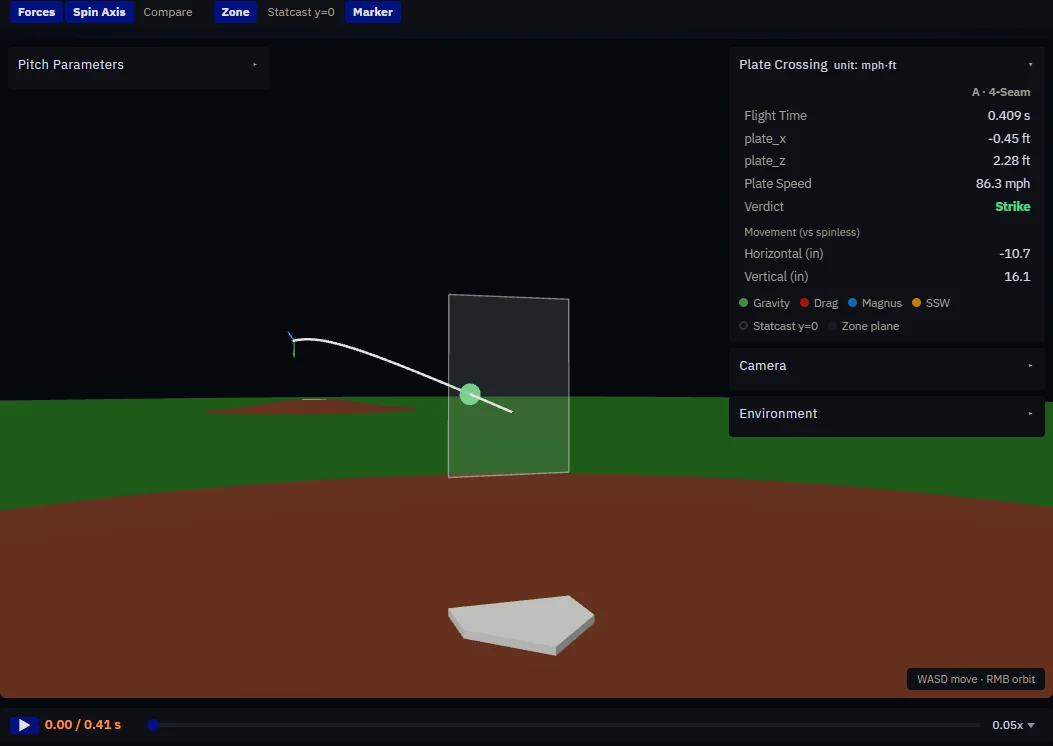
How does a ball traveling ninety-five miles per hour fool some of the fastest reactions on the planet? As a baseball flies, the air pushes a spinning ball sideways — that is the Magnus effect. The force is not large, but the ball spends a few tenths of a second in the air, enough to deflect it by several inches. Which way it moves depends on which way it spins: a four-seam fastball's spin makes it drop less than it should, so to a hitter it seems to rise; a sweeper's spin sweeps it away toward the outer edge. Scientists settled this ledger back in the 1920s; today the high-speed cameras in big-league ballparks measure it on every single pitch. What pitchers are really training is control of that ledger.
Come drag a couple of sliders — push the spin rate to the top and you will see a ball that looks like it is breaking the laws of physics. Next up, I plan to bring in real game data, so you can put an actual pitcher's real trajectories into the lab and compare them against the ones you tuned yourself.
Technical footnote: the page renders a 3D ballpark in real time with React and three.js (react-three-fiber); the flight is integrated step by step from a physics model.